
Modal Dojo
"# Modal Dojo\n\nModal Dojo is an open-source Python SDK for RL post-training on [Modal](https://modal.com).\n\nThe library takes care of infrastructure concerns such as cluster topology, Ray/NCCL bring-up, volume mounts, checkpointing, and serving for eval and rollouts, so you (or your agent!) can focus on training models.\n\nTo get started, you can go through the [Quickstart](#quickstart) section below, or paste the prompt below into your favorite agent:\n\n```txt\nInstall the `modal-dojo` library. Then, install the skill bundle into the local project with `modal-dojo skills install`. Finally, tell the user that they can ask you to do something like: \"Walk through tutorials/rl_basics.py and train Qwen3.5-4B to write 5-7-5 haikus from statworx/haiku.\"\n```\n\n## Quickstart\n\nRequirements:\n\n- Python 3.12\n\nInstall the package directly:\n\n```bash\nuv pip install -q git+https://github.com/modal-projects/modal-dojo.git@main\n```\n\nOr pin it in `pyproject.toml`:\n\n```toml\nmodal-dojo = { git = \"https://github.com/modal-projects/modal-dojo.git\", branch = \"main\" }\n```\n\nAuthenticate with Modal:\n\n```bash\nmodal setup\n```\n\nSet up the [dashboard](https://dojo.modal.dev/guides/dashboard):\n\n```bash\nmodal-dojo setup\n```\n\n<div class=\"tg-dashboard-previews\">\n <span>\n <img src=\"/homepage.gif\" alt=\"Training runs list in the Modal Dojo dashboard\" width=\"100%\" />\n </span>\n <span>\n <img src=\"/longrun.gif\" alt=\"Long-running training run details in the Modal Dojo dashboard\" width=\"100%\" />\n </span>\n</div>\n\nAnd empower your agents with the Modal Dojo's skill bundle:\n\n```bash\nmodal-dojo skills install\n```\n\nThen, it's as easy as:\n\n<!-- BEGIN QUICKSTART -->\n```python\nimport re\n\nfrom modal_dojo import (\n HuggingFaceDataset,\n Qwen3_5_4B,\n Qwen3_5_4B_Recipe,\n TrainConfig,\n)\n\nmodel = Qwen3_5_4B()\n\n\nasync def gsm8k_rm(args, sample, **kwargs) -> float:\n text = model.parse_response(sample.response or \"\").content\n boxed = re.findall(r\"\\\\boxed\\{([^}]+)\\}\", text)\n pred = boxed[-1] if boxed else (re.findall(r\"-?[\\d,]+(?:\\.\\d+)?\", text) or [\"\"])[-1]\n try:\n return float(float(pred.replace(\",\", \"\")) == float(sample.label))\n except ValueError:\n return 0.0\n\n\nconfig = TrainConfig(\n model=model,\n dataset=HuggingFaceDataset(\n hf_repo=\"skrishna/gsm8k_only_answer\",\n hf_split=\"train[:120]\",\n input_column=\"text\",\n output_column=\"label\",\n input_format=\"text\",\n ),\n recipe=Qwen3_5_4B_Recipe(\n custom_rm_function=gsm8k_rm,\n ),\n)\n\nif __name__ == \"__main__\":\n run = config.launch()\n print(run.training_run_id)\n```\n<!-- END QUICKSTART -->\n\nFor a step-by-step walkthrough, see the [Getting started tutorial](https://dojo.modal.dev/tutorials/rl_basics).\n\n## Supported models\n\n<!-- BEGIN MODELS LIST -->\n<!-- Auto-generated by scripts/generate_models_table.py from the recipe registries in modal_dojo/train_recipes/*/__init__.py. -->\n\n| Family | Models |\n|---|---|\n| DeepSeek | <ul><li>[DeepSeek-V4.1-Flash](https://huggingface.co/deepseek-ai/DeepSeek-V4.1-Flash)</li></ul> |\n| GLM | <ul><li>[GLM-4.7](https://huggingface.co/zai-org/GLM-4.7)</li></ul> |\n| Gemma | <ul><li>[gemma-4-26B-A4B-it](https://huggingface.co/google/gemma-4-26B-A4B-it)</li></ul> |\n| Inkling | <ul><li>[Inkling-Small](https://huggingface.co/thinkingmachines/Inkling-Small)</li></ul> |\n| Kimi | <ul><li>[Kimi-K3](https://huggingface.co/moonshotai/Kimi-K3)</li></ul> |\n| Moonlight | <ul><li>[Moonlight-16B-A3B-Instruct](https://huggingface.co/moonshotai/Moonlight-16B-A3B-Instruct)</li></ul> |\n| Qwen3 | <ul><li>[Qwen3-0.6B](https://huggingface.co/Qwen/Qwen3-0.6B)</li><li>[Qwen3-1.7B](https://huggingface.co/Qwen/Qwen3-1.7B)</li><li>[Qwen3-4B](https://huggingface.co/Qwen/Qwen3-4B)</li><li>[Qwen3-8B](https://huggingface.co/Qwen/Qwen3-8B)</li><li>[Qwen3-ASR-1.7B](https://huggingface.co/Qwen/Qwen3-ASR-1.7B)</li><li>[Qwen3-VL-8B-Instruct](https://huggingface.co/Qwen/Qwen3-VL-8B-Instruct)</li></ul> |\n| Qwen3.5 | <ul><li>[Qwen3.5-0.8B](https://huggingface.co/Qwen/Qwen3.5-0.8B)</li><li>[Qwen3.5-2B](https://huggingface.co/Qwen/Qwen3.5-2B)</li><li>[Qwen3.5-4B](https://huggingface.co/Qwen/Qwen3.5-4B)</li><li>[Qwen3.5-9B](https://huggingface.co/Qwen/Qwen3.5-9B)</li></ul> |\n| Qwen3.6 | <ul><li>[Qwen3.6-27B](https://huggingface.co/Qwen/Qwen3.6-27B)</li><li>[Qwen3.6-35B-A3B](https://huggingface.co/Qwen/Qwen3.6-35B-A3B)</li></ul> |\n| Qwen3.8 | <ul><li>[Qwen3.8-27B](https://huggingface.co/Qwen/Qwen3.8-27B)</li></ul> |\n<!-- END MODELS LIST -->\n"
Modal Dojo is an open-source Python SDK for RL post-training on Modal.
The library takes care of infrastructure concerns such as cluster topology, Ray/NCCL bring-up, volume mounts, checkpointing, and serving for eval and rollouts, so you (or your agent!) can focus on training models.
To get started, you can go through the Quickstart section below, or paste the prompt below into your favorite agent:
Install the `modal-dojo` library. Then, install the skill bundle into the local project with `modal-dojo skills install`. Finally, tell the user that they can ask you to do something like: "Walk through tutorials/rl_basics.py and train Qwen3.5-4B to write 5-7-5 haikus from statworx/haiku."Quickstart
Section titled “Quickstart”Requirements:
- Python 3.12
Install the package directly:
uv pip install -q git+https://github.com/modal-projects/modal-dojo.git@mainOr pin it in pyproject.toml:
modal-dojo = { git = "https://github.com/modal-projects/modal-dojo.git", branch = "main" }Authenticate with Modal:
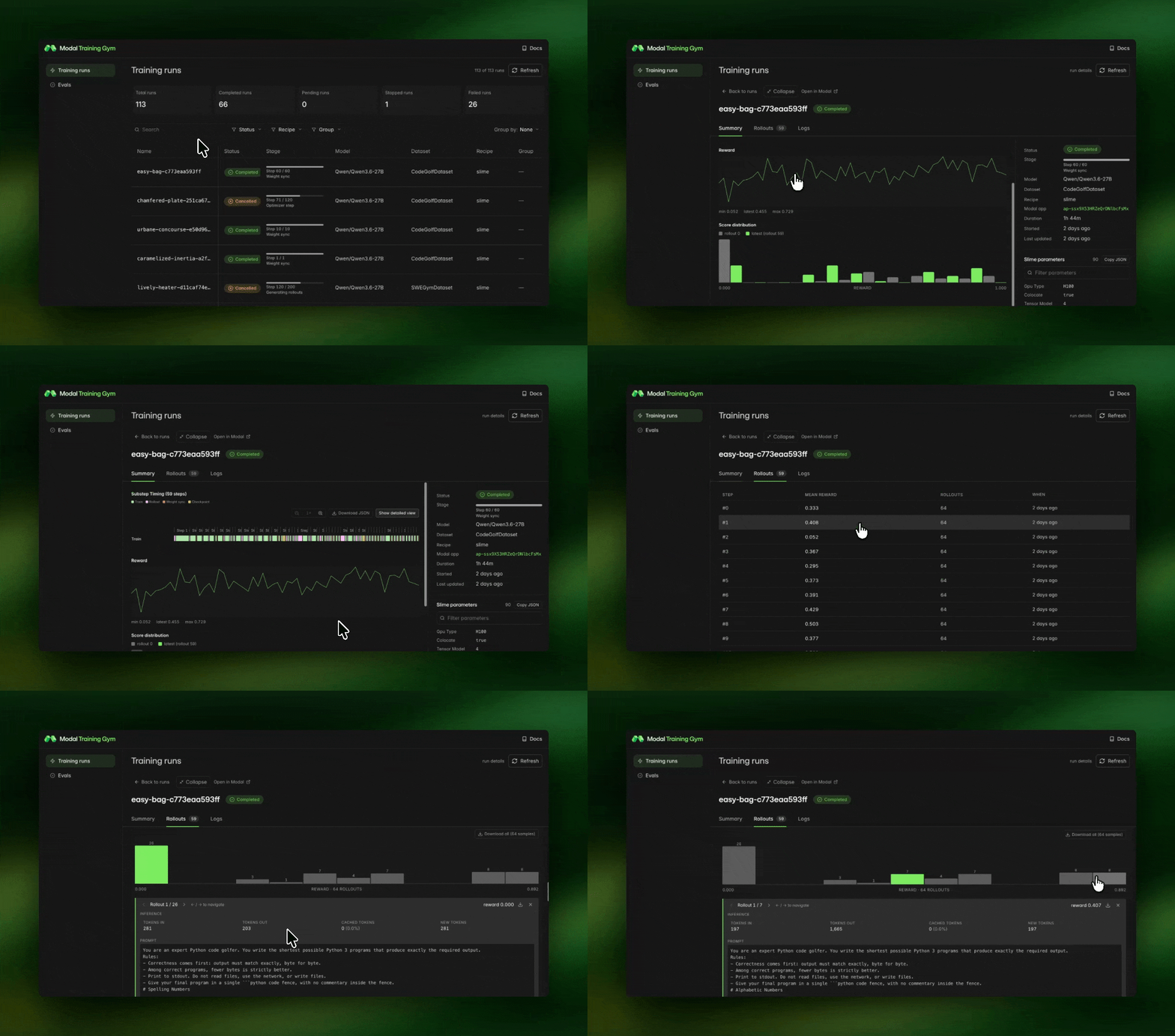
modal setupSet up the dashboard:
modal-dojo setup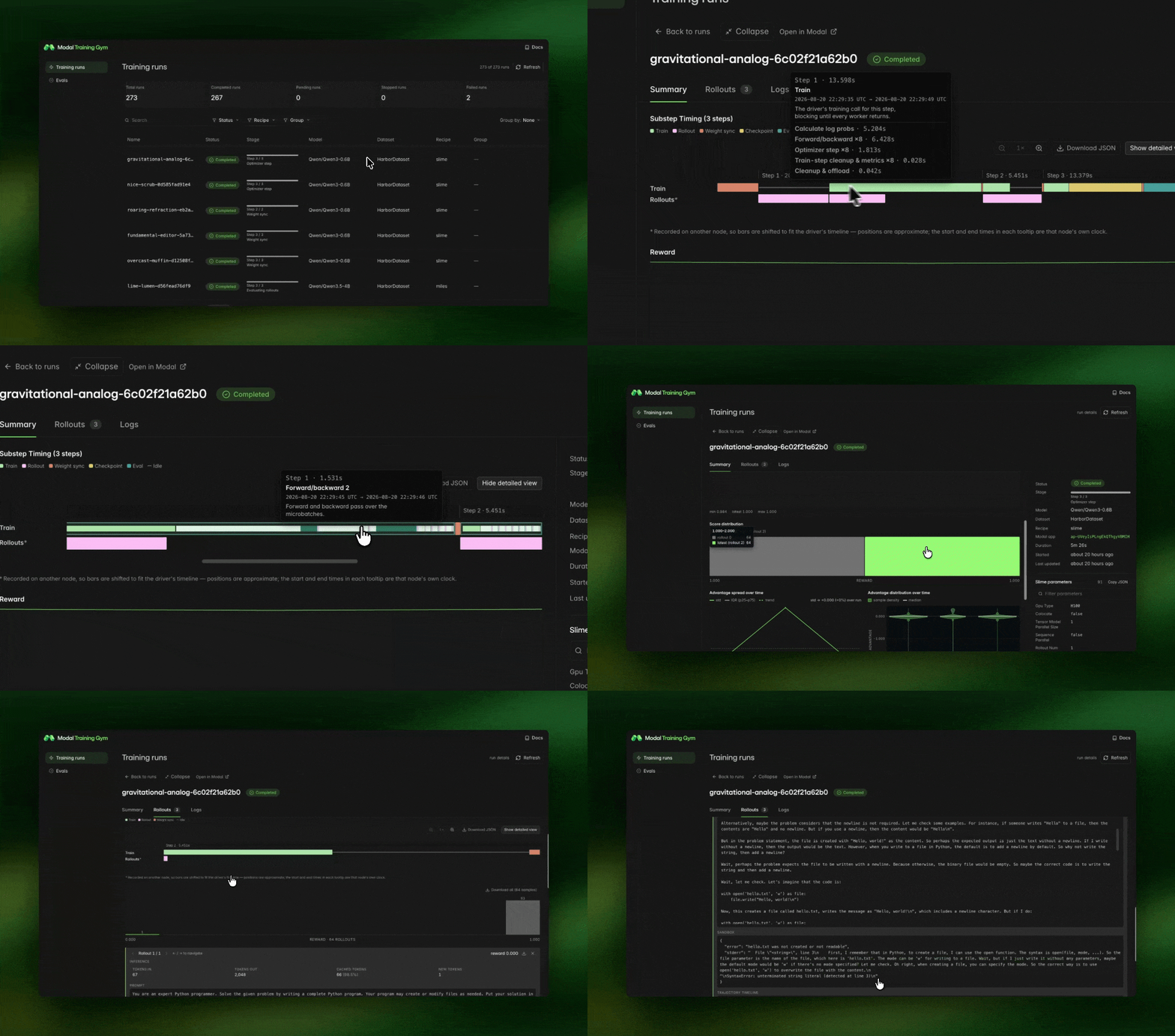
And empower your agents with the Modal Dojo’s skill bundle:
modal-dojo skills installThen, it’s as easy as:
import re
from modal_dojo import (    HuggingFaceDataset,    Qwen3_5_4B,    Qwen3_5_4B_Recipe,    TrainConfig,)
model = Qwen3_5_4B()

async def gsm8k_rm(args, sample, **kwargs) -> float:    text = model.parse_response(sample.response or "").content    boxed = re.findall(r"\\boxed\{([^}]+)\}", text)    pred = boxed[-1] if boxed else (re.findall(r"-?[\d,]+(?:\.\d+)?", text) or [""])[-1]    try:        return float(float(pred.replace(",", "")) == float(sample.label))    except ValueError:        return 0.0

config = TrainConfig(    model=model,    dataset=HuggingFaceDataset(        hf_repo="skrishna/gsm8k_only_answer",        hf_split="train[:120]",        input_column="text",        output_column="label",        input_format="text",    ),    recipe=Qwen3_5_4B_Recipe(        custom_rm_function=gsm8k_rm,    ),)
if __name__ == "__main__":    run = config.launch()    print(run.training_run_id)
For a step-by-step walkthrough, see the Getting started tutorial.
Supported models
Section titled “Supported models”| Family | Models |
|---|---|
| DeepSeek | |
| GLM | |
| Gemma | |
| Inkling | |
| Kimi | |
| Moonlight | |
| Qwen3 | |
| Qwen3.5 | |
| Qwen3.6 | |
| Qwen3.8 |